
Tales from the Mad Hatter-Part I
By Kate Lavelle
Hat vases, people either love them or hate them. I’m among the folks who love them, although my dear husband has never quite understood my long-term fascination with them. To me, they’re just ever so appealing and I really enjoy collecting these little charmers. You could say that I’m mad for them. And I’m far from alone; I have many fellow “Mad Hatters” in the Carnival Glass world. Being a lifelong fan of Lewis Carroll’s, I’m naming this series of articles after the Hatter character in his stories Alice’s Adventures in Wonderland and Through the Looking Glass.
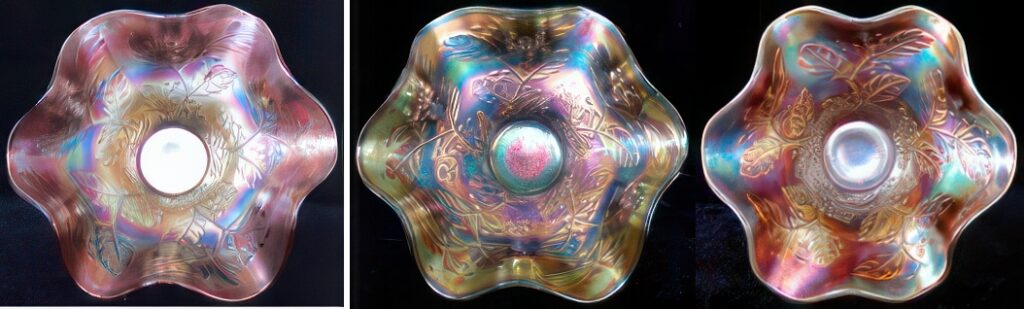
From left to right are Kate’s aqua, sapphire, and sapphire opal Holly ruffled hats.
 orig
orig
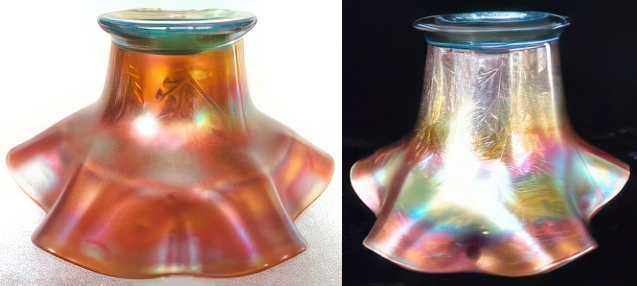
Comparison of the aqua color on the left with the sapphire opal on the right.
A most delightful aspect of collecting hat vases is that they are small and sport such a versatile range and selection of colors, and shapes as well. Besides being suitable for holding small bouquets, such as violets or lily of the valley for example, they were used for a number of purposes – to hold candy or sweets (perhaps at a tea party with Alice, The March Hare, and The Dormouse!), jewelry, and many other small trinkets and treasures. Nowadays, hat vases have become a fairly popular sub-collection genre.
Fenton was the major producer of hat vases, but there’s also Dugan and Northwood. If you consider tumbler whimseys to also be hat vases as I do, then you can add a few more companies to the short list. Of the hat vases that I own, 75% are by Fenton in ten different patterns.
Because it’s Christmastime, we’ll begin our exploration with Fenton’s Holly hat vases. Holly was a very successful pattern for Fenton in all of its various shapes: plates, bowls, rosebowls, compotes, and of course, the humble hat vase. It has been found in the following shapes or edge treatments: ruffled, candy ribbon edge or crimped, two sides up, jack-in-the-pulpit, crimped jack-in-the-pulpit, tricornered, and square.
Most are fairly uniform, but sometimes they are found spread so wide and so low that they hardly conform to the quintessential hat vase shape and appear more like short bowls or odd low ruffled plates. A very similar pattern also by Fenton is Pepper Plant, which is often found with the hexagonal bottom. Holly was never produced with that base. Additionally, Holly always has three berries on each stem, where Pepper Plant will show sprigs with only one “berry” or “pepper.” “Not the same thing a bit!” said the Hatter.
The spectrum of colors available in the Holly hat vase is also delightfully broad. A collector may select their choice from a veritable Wonderland of colors and shades. They have been reported and documented in amber, amber opal, amberina, amethyst, amethyst opal, aqua, aqua opal, blue, green, lavender, lavender opal, lime green, marigold, marigold on moonstone, peach opal, powder blue, red, reverse amberina, sapphire, teal, vaseline, and violet. I wouldn’t be too surprised to find that there are amberina opal, vaseline opal and yellow Holly hat vases out there as well. Red, amberina and aqua will be more on the expensive side, as will all of the opals. Fenton probably did not intentionally make these opal wonders; they are more likely oddities caused by being overheated or reheated whilst being shaped. At least that’s what I have been told by many mentors.
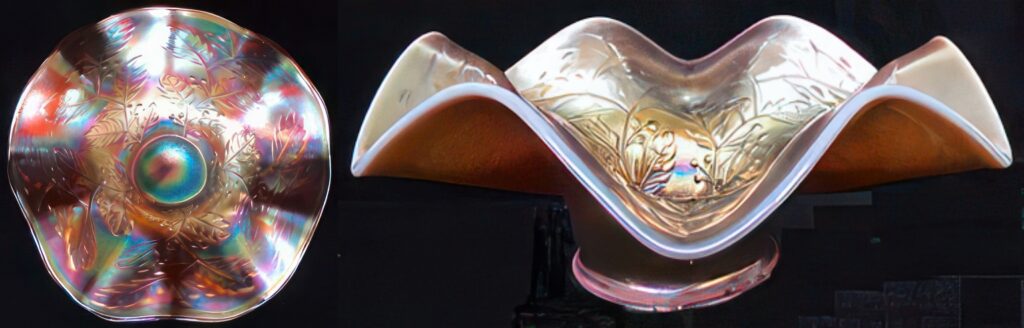
Lavender, left, and lavender opal, on the right, are represented in Kate’s collection, as well.
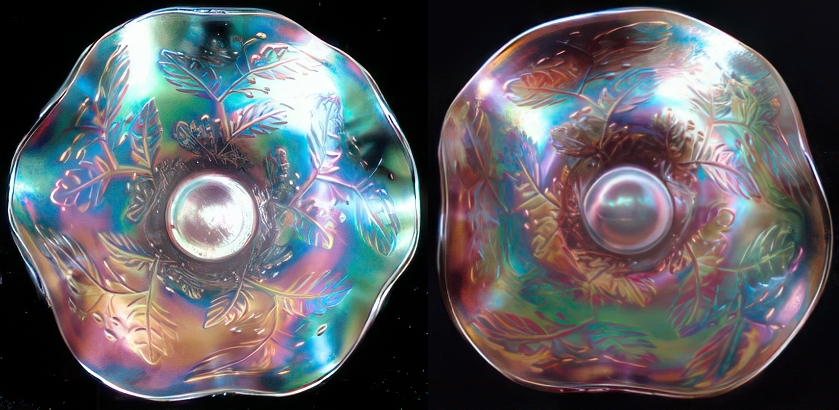
On the left is a blue example and featured on the right is a vaseline.
Please do join us again in the next issue of the ICGA Carnival Pump for another installment of the Mad Hatter series. And remember it’s always teatime in Wonderland, so please do Kill those Holly hat vases with something sweet for us all to eat.
Photos courtesy of Kate Lavelle
This article first appeared in the ICGA Pump in the December 2014 issue and is reprinted with permission.