
Standard Vases
By Dr. Larry Keig
Standard vases are generally of little interest to collectors because their surface color and iridescent treatment are of marginal quality. But there is an exception.
Pattern Description and Colors
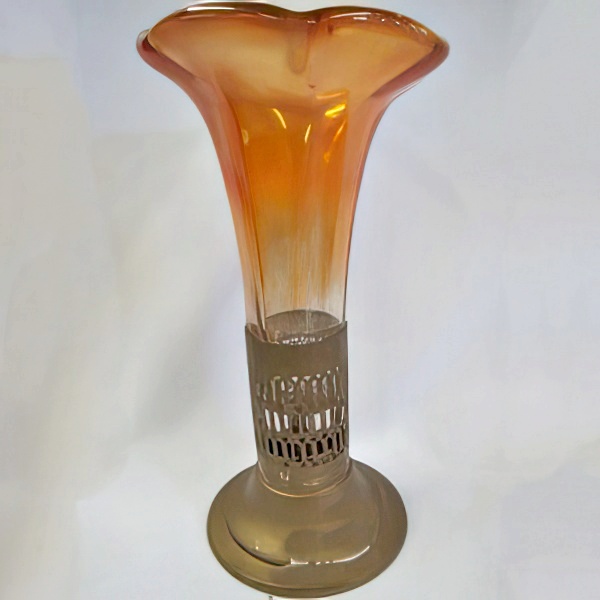
A complete Standard carnival vase is a two-piece unit consisting of a flower holder and a supporting base. The vase is glass, the base metal. The vase will not stand upright unless placed in a base specifically designed to hold it.
The glass receptacle is simply designed. Its interior is made up of eight concave panels which run from the flat-ruffled top to the base. The exterior is unpatterned. Its ruffled top is shaped much like many of Dugan’s Lattice and Points, Circle Scroll, and Nautilus, and Diamond’s Optic, vases. Its top is slightly less than three inches in diameter. The glass receptacles range from six to seven inches tall.
The base is made up of a cylinder in which the container is inserted and a rounded and elevated support stand. The cylinder has a reticulated surface. The surface of the support stand is non-porous. The stand is about three inches tall, its base approximately three inches in diameter.
Until recently, the only reported surface color was marigold. Most of these are of a light shade with little in the way of iridescent treatment.
A few years back, a white example surfaced on eBay. Its container is about four inches tall and it appears not to have been swung. According to the seller, it had been in a collection in a small town near Indiana, Pennsylvania, where the Dugan and Diamond glassmaking factories operated.
Its frosty white texture and pastel iridescence look like the white produced by Diamond in the early 1920s. If it is Diamond, it would be in good company, as the white Coin Spot compotes, known to have been made at Indiana, Pennsylvania, were probably made in the early ‘20s.
The Matter of Maker
The maker of Standard vases is technically unknown. However, there are clues as to where they were made and when.
Most patterns designed and crafted during the Dugan years of the factory are more intricate and elaborate than those made by Diamond. Moreover, nearly all of Dugan’s are patterned on the most visible surface: for example, interiors of bowls and plates and exteriors of vases, if not on both surfaces. Diamond’s patterning is often found on an area that is tough to see at a glance, with no patterning elsewhere. And even what patterning there is is usually compromisingly simple.
The top shape of these vases provides circumstantial evidence as to maker. The flat ruffling is a hallmark of glass made in western Pennsylvania but nowhere else.
Marigold was a scarce Dugan surface color but by far Diamond’s most common. Marigold Standard vases are rarely blessed with colorful iridescence.
Most white carnival was made during the Dugan years. The color essentially disappeared from production during the early teens of the twentieth century only to be revived by Diamond in limited quantities in stretch and other lines in the early ‘20s. The anomalous white Standard vase may be from this time frame of production.
Dugan made and marketed several of its carnival patterns with metal frames in the late pre-teens of the 20th century. Diamond may also have made and sold them in the very early teens. All were likely niche items offered in limited quantities for only a short time.
The evidence seems to suggest that Standard vases were made at the Indiana, Pennsylvania glassmaking plant. Whether they were made during the Dugan years or by Diamond is more difficult to determine.
If any were produced by Dugan, they were almost certainly made just before the ownership of the plant changed hands in mid-1913. A more likely attribution is manufacture during the very early Diamond years, for various explanations offered above. It seems probable the marigold were made during this transition period, the white during what is often described as Diamond’s stretch glass era.
This article is printed with permission.