
Diamond Lace
By Barb Chamberlain
The Imperial Art Glass Company produced the Diamond Lace pattern. This is a geometric design like many other Imperial designs. A very limited number of shapes are known in this pattern. There are two basic sizes of bowls, a large eight to nine inch and a berry bowl size. These bowls can be found in ruffled and ice cream shape. The only other shapes known are the pitcher and tumbler.
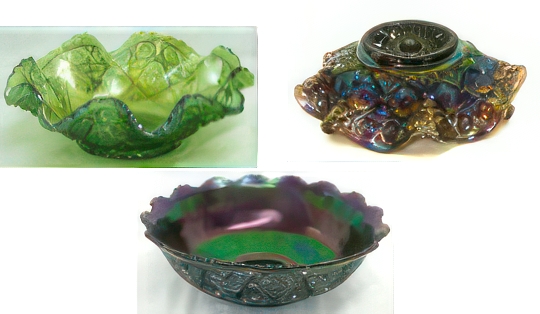
Master and small berry bowls in the Diamond Lace pattern can be found in ruffled or flared style. Above left is a green ruffled bowl. To its right is an amethyst ruffled bowl shown upside-‐ down to show the pattern. On the bottom, is the ruffled example is a flared bowl.
The bowls are found in several colors. The most common colors are marigold, pastel marigold, and clambroth. They are less frequently found in green and purple. Purple would probably be considered the most desirable. None of these bowls are found frequently, and with the pattern on the exterior, many people aren’t excited to collect them. If you could display them sitting on the base in a high area, the pattern could be displayed to its maximum. Some people might display them in holders with the back pattern showing.
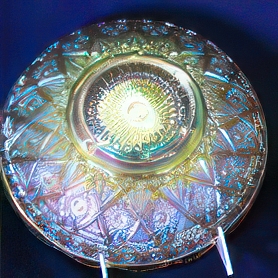
Above is an ice cream shaped bowl in either a pastel marigold or clambroth. Note the pink, yellow, and blue highlights in the spectacular iridescence.
The pitchers and tumblers are found with more regularity than the bowls. The only drawback is that the pitchers have only been found in purple or lavender. Generally, these pitchers exhibit beautiful iridescence and can be a star in a collection of water sets. The tumblers are found frequently in purple and lavender, as well, but if you find a marigold tumbler, you have a treasure. Only a few of these have been found.
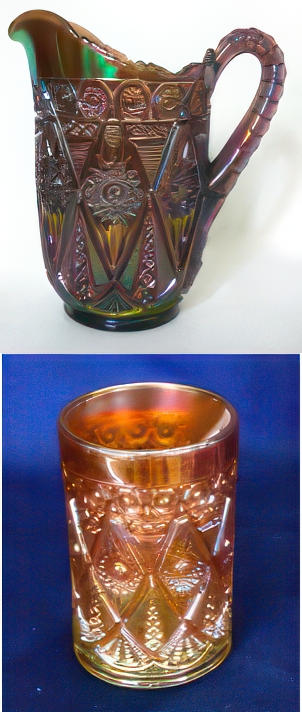
On the top is a fabulous lavender Diamond Lace water pitcher with spectacular iridescence. Nearly all the Diamond Lace pitchers have great iridescence. Underneath is a marigold Diamond Lace tumbler is one of a few known. It would be a great addition to an Imperial or tumbler collection.
In the October 1995 HOACGA bulletin, John Britt reported a variation of a Diamond Lace tumbler. This one had a ground base, but with the possibility that it had the edge ground to remove damage, it still remains a variant. It is shorter, and on the normal collar-based tumblers, there is a 16-point star on the base, while the one with no collar base has a 24-point star. We have two Diamond Lace tumblers, both with collar bases, and both with the “normal” 16-point star.
The highlight of a collection would be a whimsey. Finding one is the challenge. There is a beautiful rosebowl that was shaped from a marigold tumbler. This rosebowl exhibits no collar base. Could it have been made from the variant tumbler?
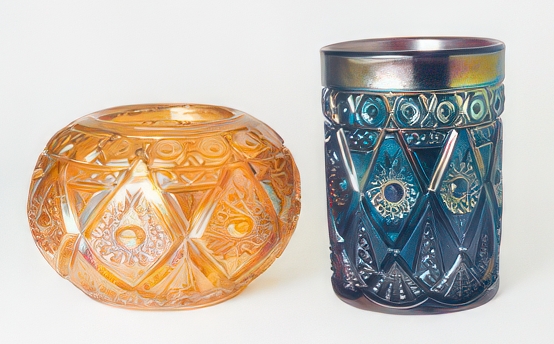
Above left is the marigold whimsey rosebowl made from the variant tumbler. An example of the variant tumbler is on the right. As you see both the rosebowl and the tumbler do not have the collar base. The majority of tumblers are found with a collar base. Be sure to check the number of points on the star on the base to note the difference, as well. Photo courtesy of Dave Doty.
Another challenge would be to find the water pitcher in marigold! If marigold tumblers exist, could a complete water set be found? I would love to find one. Also, no marigold pitchers have been reported.
The Diamond Lace bowls were reproduced in the 60s and 70s, so if you think you have a bowl in a color or shape that isn’t reported, look for the IG mark. It will probably be there. These reproductions are often found in a larger rosebowl shape in amethyst, blue, and red. There are also some even more recent white vases and blue bowls produced and marked with an “S” for Smith.
I would like to hear from you if you have some other shape or color that I don’t have included in my article. Please send information to me at [email protected] or to 124 E. Honey Creek Dr., Manchester, IA 52057. Please include a photo, if possible. Any further information will be reported in an issue of The Pump.
Other photos in this article were provided by Seeck Auctions
This article first appeared in the ICGA Pump in the December 2014 issue and is reprinted with permission.