
Tales from the Mad Hatter Part II-Fenton Blackberry Spray & Family
By Kate Lavelle
It’s time once again, my fellow Mad Hatters, for another installment in our series on the often overlooked, yet perpetually appealing, humble hat vase. In this article we’ll focus on another well-known classic by Fenton – their pattern #1216: Blackberry Spray, its two-spray Variant, Blackberry Banded, and the Stretch Glass version Absentee Variant #106.
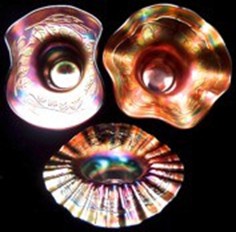
Here are three popular shapes of the Blackberry Spray pattern. From left top to bottom: two sides up, six ruffled, JIP tightly crimped.
This is another phenomenal hat vase pattern that offers the complete Wonderland of Fenton Delights by being manufactured in such a broad spectrum in regard to color palette, shaping, and edge treatment. There’s certain to be at least one item suitably satisfying to any carnival or other type of glass collector. Collecting one in each color and in every form would, without doubt, prove to be a most remarkable challenge that would require years of good and amusing hunting.
Proving popular with the public even prior to carnival glass production, this is an old, well known and frequently used shape. How very pleasant it is for we hatters to revel in the very plentiful selection of them yet available to us in 2015. This pattern was produced prior to 1908 and can be seen in several Butler Brothers trade advertisements from that period as early as 1911 and well on into the 1920s. In Fenton Glass: the First Twenty-Five Years by William Heacock several of these black and white and colored ads from over the years can be seen offering many varieties of these charming hat vases.
Besides their long-term production in carnival glass, these hat vases were also widely produced by Fenton in several non-iridized colors and in opalescent shades as well. Examples of these can also be found in enameled milk glass and opalescent goofus. By 1930 carnival glass was missing from the Fenton catalogues, but Blackberry Spray pieces were offered in the uniridized Depression glass colors called “rose pink” and “emerald green.” Also relevant is the stretch glass cousin, known as the Blackberry Spray Absentee Variant, also known as Fenton’s pattern #106. These may be available in the Fenton stretch glass colors of amber, aquamarine, celeste blue, Florentine green, Grecian gold, Persian pearl, royal blue, ruby, tangerine, topaz, velva rose and wistaria (sic).
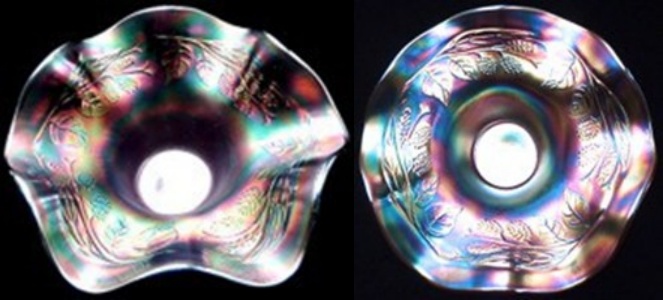
On the left is a four-spray Blackberry Spray hat in blue. On the right shows a magnificent red hat with the four sprays of Blackberries.
On eBay and elsewhere Blackberry Sprays are often misnamed “Wheat” or “Sheaves of Wheat” by laymen not educated in carnival glass patterns. This versatile pattern is aesthetically pleasing, yet simple in all of its various shapes. It has been found in the following shapes or edge treatments: ruffled, tightly crimped, two sides up, jack-in-the- pulpit, crimped jack‐in-the-pulpit, tri-corner, tightly crimped and four sides up or square. Within these various shapes, there is a range of height as well; there are some flared very wide and very low, almost like a plate and other low ones with a marvelously flared and fascinating crimped edge. Some JIPs are high and tight, while others are spread incredibly low and wide. Most examples are about six inches in diameter at the top, but the widely flared pieces can be seven inches or even larger. This diversity in form alone is an integral part of the real joy in collecting Blackberry Sprays. Many of my own Blackberry Sprays sport gorgeous stretch iridescence, these specimens are particularly desirable among collectors.
I can’t say for sure as it’s purely speculative conjecture, but it’s my opinion that the two‐spray variant was perhaps Fenton’s prototype for the more commonly seen four‐spray. Perhaps Frank Fenton, like his brother John often did with his Millersburg patterns, felt that there was just not enough detail on the two-spray variety and instructed his mold maker to extend the sprays into a ring of four. When one notes that there are dozens of standard Blackberry Sprays for everyone seen with the two sprays this theory makes sense.
These two-spray examples do not seem to be valued more than the standard form in any substantial way; it’s just another interesting variation for the collector to embrace.
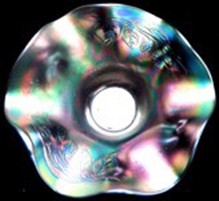
Pictured above is an example of the two-spray Blackberry Spray pattern in blue.
Blackberry Banded hat vases are also much rarer to find than the usual Blackberry Spray. This mold has the usual ring of four sprays of blackberries, but this is followed by a five-eighth inch ring of narrow vertical lines, ending in four clumps of four blackberries hanging downwards towards the interior bottom. These are generally found in ruffled or four sides up and with a significantly limited number of available colors including, but not necessarily limited to: amethyst, blue, green, marigold, marigold on moonstone, red and white.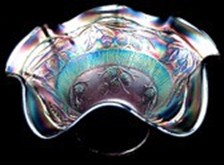
The Blackberry Banded hat features the sprays of blackberries, the striated band, and the drooping blackberries falling to the bottom of the hat.
Alternatively, or “Contrariwise” if you will, the amazing rainbow of colors that Blackberry Spray vases were manufactured in is pure rapture. If you can imagine it, it likely exists. We can give a fairly comprehensive list of these colors, realizing that it is not limited to these alone. Thus far, they have been reported and documented in amber, amber opal, amberina, amberina opal, amethyst, amethyst opal, amethyst slag, aqua, aqua opal, blue, blue opal, green, lavender, lavender opal, lime green, lime green opal, marigold, powder blue, red, red opal, reverse amberina, reverse amberina opal, sapphire, sapphire opal, vaseline, and white. I wouldn’t be too surprised to find that there are vaseline opal and yellow Blackberry Spray hat vases out there as well. Red and amberina will be more on the expensive side, as will all of the opals. As with some of their other patterns, Fenton probably did not intentionally make these opal wonders; again, they are more likely oddities caused by being overheated or reheated whilst being shaped. None of these hat vases have an exterior pattern. I have found only a slight difference in base sizes: Blackberry Spray and the two-spray variant both have a two and five-eighth inch base, while Blackberry Banded is smaller at two and three-eighth inch diameter.
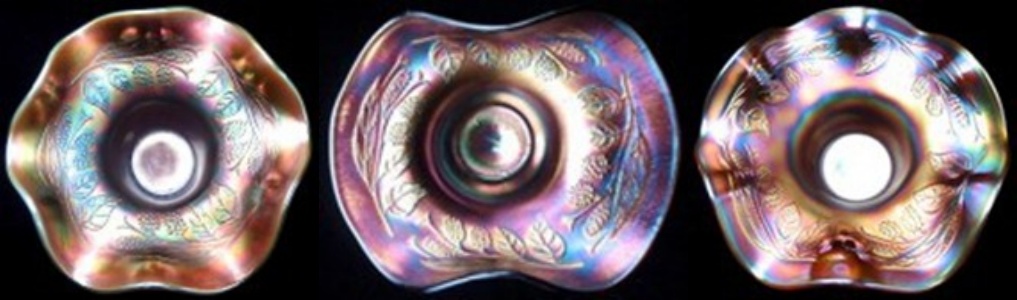
The hat on the left is one of the more coveted colors is this aqua opal six ruffle hat. The middle piece would be hard to find a better example of the amethyst two sides up hat. On the right is a vaseline hat. Although this doesn’t look vaseline, it will glow under a black light. Perhaps you can see a touch of the color on the right side of the piece
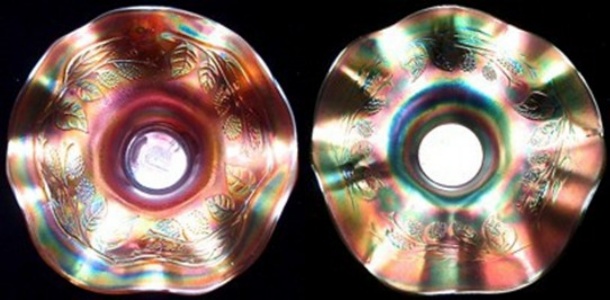
Amber is the color of this beautiful six ruffle hat vase on the left. On the right is a green hat that is not exactly easy to find.
If you feel that hat vases are ho-hum and not worth much, think again. There is a whole slew of carnival glass collectors who positively adore their hat vases. And they’re willing to part with a shilling or two to get the object of their desire. There is a Blackberry Spray ruffled “amberina opal slag” specimen up on eBay at present. If you’re fantasizing about adding this item to your collection the seller is offering it for a mere $3,752.50. Who said hat vases are cheap to collect? In an in-depth review of Tom Mordini’s Auction Price Guides from 1996 to 2013 there were a great many Blackberry Spray hat vases that sold for over $500. These were consistently rare colors; aqua opal, amberina, red, reverse amberina opal, red opal etc.
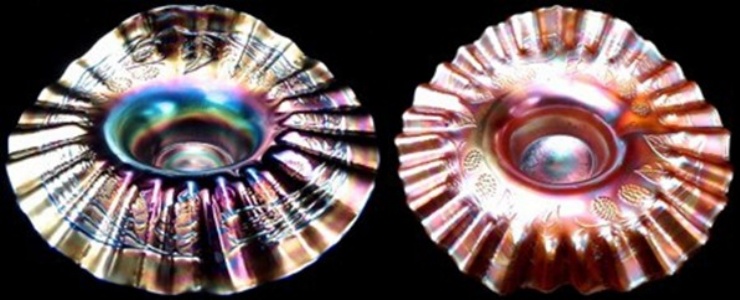
One of the shapes that is popular with many of us is the tightly crimped jack‐in‐the‐pulpit shape pictured left in blue and right in marigold.
Please do join us again in the next issue of the ICGA Carnival Pump for another installment of the Mad Hatter series. And remember, “It’s always teatime in Wonderland,” so always keep your Blackberry Spray hat vases handy to fill with something sweet for us all to eat. You never know, the next Tea Party may be at your cottage!
Photos courtesy of Kate Lavelle.
This article first appeared in the ICGA Pump in the March 2015 issue and is reprinted with permission.