
Fenton’s Cherry Blossoms
By Lee Markley
Cherry Blossoms is the Fenton version of this enameled pattern. The Thistlewoods in a June 1993 The Carnival Pump article entitled “Life’s a Bowl of Cherries” explore the ways to differentiate between the Fenton and Northwood versions. The main point is that the Fenton version was made in a two-part mold while the Northwood was from a four-part mold. They also pointed out the differences in the decorating work. According to their research, the Fenton pitcher may also have a plain interior or a draped one. The Northwood may have a paneled interior.
One of the decorating differences they pointed out was that the Fenton version had nine daisies surrounding the five cherries. Another difference they didn’t note was that the daisies all have nine petals, and there are no leaves from the two groups of three cherries on either side.
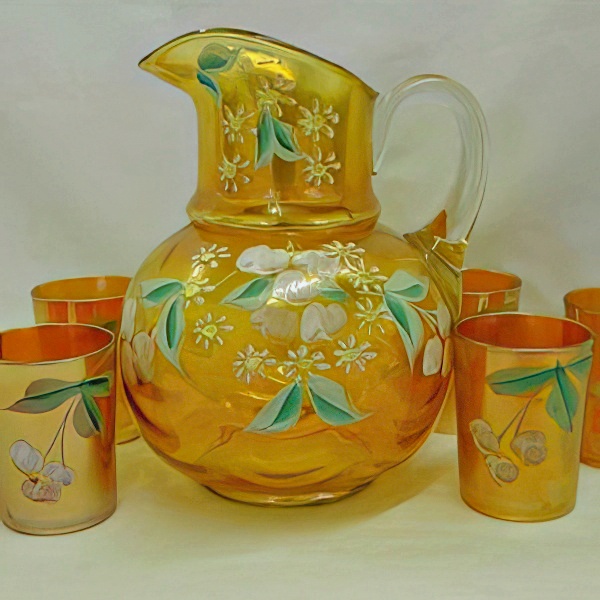
The Fenton Enameled Cherry Blossoms pitcher of Lee’s features nine flowers each with nine petals.
The pitcher shown is twenty-three inches in circumference and ten inches tall. The base diameter is four inches and the top four and one-half inches. It is spade shaped. There are two mold lines, and the handle is applied. There is a collar base that is plain. The sets were made in blue and marigold, but amethyst is possible.
The design has a large spray of leaves across the back. On the front side at the top above the ringneck are two large leaves that arch to the right on a simple stem that leads to a smaller pair of leaves in the center of the five daisies that have nine petals each. The stem divides above the ring. Below the ring there is no pair of leaves. Two stems attach to the top two cherries in the cluster of five. There is a single leaf on either side of the central cherry. There are nine daisies each having nine petals. The fifth one has a pair of large green leaves under it. The second and eighth daisies have two large leaves that are connected to the two top cherries in each cluster. The third in each group has no stem, nor are there any leaves.
The Thistlewoods did an extensive comparison and study of the cherry pattern tumblers in an attempt to determine which belong with which pitcher – Fenton or Northwood. They came to the conclusion that the tumbler with the two or three little leaves protruding from the bottom cherry is the one that matches the Fenton pitcher. According to Hand and Owens, some of the cherry tumblers like that had an N in the bottom which would tend not to support that conclusion. However, I’ve not seen this particular tumbler marked like that. Mine are all unmarked, both blue and marigold. The amethyst one shown in Cecil Whitley’s book was also unmarked. I would tend to submit that the Thistlewood attribution is correct. However, two of the tumblers accompanying the pitcher in the picture more closely match the design elements of the pitcher in that they have no leaves at the bottom, just like the cherries on each of the pitcher design.
The tumblers in my picture are three and three-quarter inches tall and have a top diameter of two and three-quarter inches and a base diameter of two and three-eighths inches. The base is ground. The decoration is only on one side. It has three green leaves on a stem that splits in two going to the top two cherries. The third cherry has no stem or leaves. The second type of tumbler has the same description, but there are two leaves below the third cherry.
Sources: Carwile, Mike. The Standard Encyclopedia of Carnival Glass, 12th Ed.; Doty, Dave. A Field Guide to Carnival Glass; Hand, Sherman. Colors in Carnival Glass, Book 4; Heacock, William. Fenton: The First 25 Years; HOACGA Pattern Notebook; Owens, Richard. Carnival Glass Tumblers; Thistlewood, Stephen and Glen. “Life’s a Bowl of Cherries,” The Carnival Pump, June 1993. A Century of Carnival Glass. The Art of Carnival Glass; Whitley, Cecil. The World of Enameled Carnival Glass Tumblers; Whitmyer, Margaret and Kenn. Fenton Art Glass 1907–1939.
This article first appeared in the ICGA Pump in the June 2015 issue and is reprinted with permission.
Update 6-29-25: Based on hookedoncarnival.com, the amethyst/purple has been validated.