
Northwood’s Cherries and Little Flowers
By Lee Markley
Cherries and Little Flowers is the accepted name for the Northwood version of their decorated water set. In the June 1993 The Carnival Pump, Glen and Stephen Thistlewood have a lengthy discussion concerning the Fenton and Northwood versions of this pattern. They reached the conclusion that the Northwood pitcher was made from a four-part mold and the proper tumblers were often signed and had a single leaf attached to each of the three cherries in the cluster. They also indicated the Northwood pitcher could have a smooth or paneled interior, as well as more daisies surrounding the cherry group on the side of the pitcher, namely eleven.
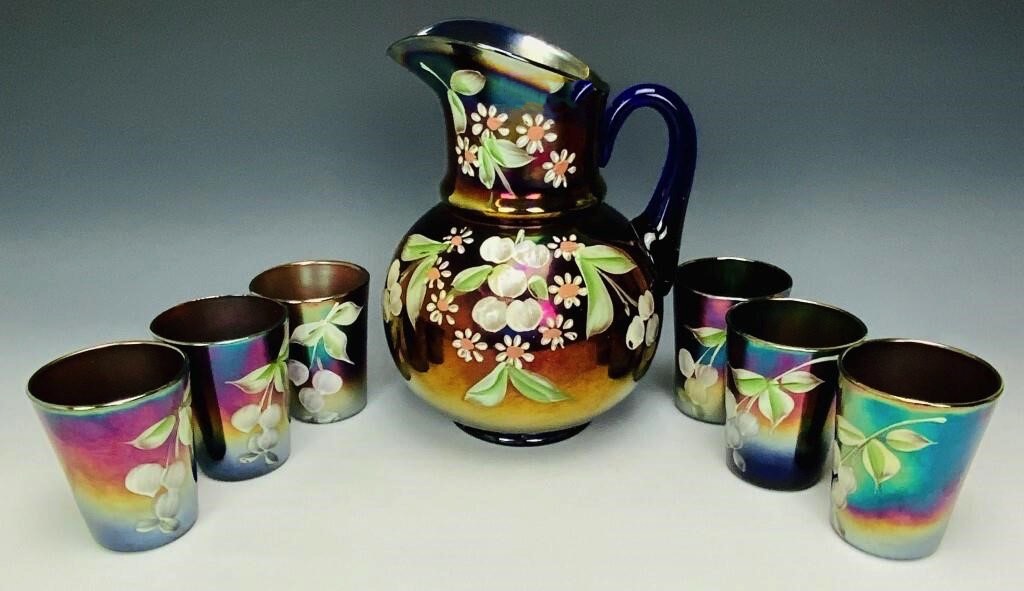
The pitcher in the photo is from a four-part mold. It differs from the one in the Thistlewood article in that it has only nine daisies. These daisies only have eight petals. The Fenton version have nine petals. The top of this pitcher is more oval shaped with a diameter of four and one‐quarter inches. The pitcher is ten and one-quarter inches tall and has a width of twenty-three and three-eighths inches. There is a collar base that is plain and four inches in diameter.
The design of the pitcher starts at the top with two green leaves on a stem that flows behind the second daisy in the semi‐circle of five. It connects to another pair of leaves and a single stem continues to the ring. Below the ring is another pair of leaves with three stems-two of which attach to the top two cherries. The third extends toward the center cherry but doesn’t quite get there. Two green leaves are placed on either side of that cherry. The fifth daisy has two green leaves below it. Between the second and third and the seventh and eighth daisies a stem extends left and right to a pair of leaves. Beyond the leaves it splits into three-one going to each of the top cherries, the third going toward the third one but not quite getting there. The big difference here is that each cherry has a separate leaf at its base. The Fenton version doesn’t have this There is a small leaf spray to the right of the handle on the back side.
The tumbler is fairly straight-sided with a top diameter of two and three-quarters inches and a base of two and one-quarter inches. It is ground and has no pattern. The mold lines are indistinct, and the tumbler is frequently signed. Some also have small numbers on the base. The tumbler is decorated on only one side. At the top coming to the left are three large leaves. The bottom two are on the two stems that are attached to the top two cherries. The third has no stem. From the bottom of each cherry is one leaf. This is the distinguishing feature, besides the signature, for this tumbler and it coincides with the two groups of cherries on each side of the pitcher design.
No auction prices have been listed as it wasn’t possible to always distinguish between the Fenton and Northwood versions.
Sources: Burns, Carl. Northwood Carnival Glass, 1908 – 1925; Carwile, Mike. The Standard Encyclopedia of Carnival Glass; Doty, Dave. A Field Guide to Carnival Glass; Hand, Sherman. Colors in Carnival Glass, Vol. 4; Heacock, William. Northwood -‐ The Wheeling Years; Owens, Richard. Carnival Glass Tumblers; Thistlewood, Stephen and Glen. “Life’s a Bowl of Cherries”; The Carnival Pump, June 1993; A Century of Carnival Glass -The Art of Carnival Glass; Whitley, Cecil. The World of Enameled Carnival Glass Tumblers; Whitmeyer, Margaret and Kenn. Fenton Art Glass, 1907 – 1939.
Photo courtesy of Seeck Auctions.
This article first appeared in the ICGA Pump in the September 2015 issue and is reprinted with permission.
Update 6-29-25: According to hookedoncarnival.com, 26 Blue Northwood watersets have sold averaging $81. The most expensive was $210, the least was $30.