Tales from the Mad Hatter Part IV – More Fenton Classics
By Kate Lavelle
Welcome one and all to the winter tea party! Yes, it’s time once again for us to continue our adventure focusing on the much beloved and multifaceted wonderland of hat vases. I must admit that when I first embarked on this series of articles I didn’t really look at it as a long-term commitment. But when I began to research each of the patterns in depth, it became abundantly clear to me that this would not be a short-term project. Enjoying these pieces as much as I, and most likely you do as well, they deserve much more attention than just a brief nod. So, pull up a chair, here’s a fine cuppa tea and let the tales commence. Do pass the lady fingers.
This installment will focus once more on a few additional Fenton delights. This time we’ll cover Peacock Tail, Pepper Plant and the Stippled Rays patterns.
Peacock Tail
Peacock Tail was a great hit for Fenton right from the start with Carnival Glass production beginning early in 1909. And with good reason; its simplistic style pleased Victorians, Art Nouveau fans, and even peacock aficionados.
Peacock Tail hat vases can have any of the usual Fenton edge treatments, as in four sides up or square, but the majority have the classic six ruffle form. Base colors can be amber, amethyst, blue, green, lime green, lime green opal, marigold, red and vaseline. Other colors wouldn’t surprise me; this is Fenton we’re talking about! Exterior bases can be round or octagonal. The interior base sports an eight petal “flower” that is echoed by fourteen ever enlarging concentric arched loops within each of the eight “feathers”. The interior edge is smooth past the loops for approximately three-fourths inch.
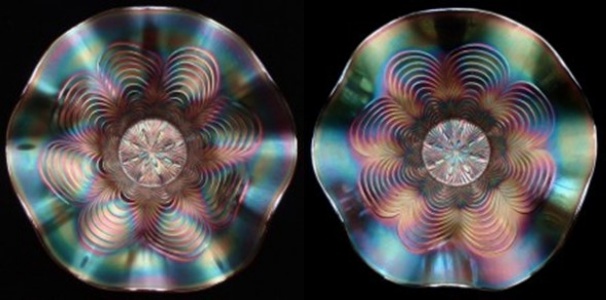
On the left is the Peacock Tail Amethyst Hat, and on the right is the Peacock Tail Green Hat
Several businesses of the period opted early on to have Fenton make the Peacock Tail hat vase pattern in green as a giveaway or memento of their business. These advertising pieces have always been and are still highly sought after and collected by a dedicated subgroup of Carnival Glass connoisseurs. The Peacock Tail advertising pieces are certainly more affordable than some other advertising patterns. According to a review of the Mordini Carnival Glass Auction Price Guides from 1996 – 2013, it is the General Furniture version that has sold the most. Nine of these changed hands within this period with prices ranging from $45 to $135. There were five Quincy Jewler (sic)-aka Arthur O’Dell Jewelers-listed, ranging from $30 to $190 in price. There were four Central Furniture listed, ranging from $55 to $75. The Truckey & Sons Dept. Store version had three, ranging in price from $100 to $355, as did the Hudson’s, Tahlequah, Okla version with $45 to $85.
Mad Hatter Update: Peacock Tail
By Kate Lavelle
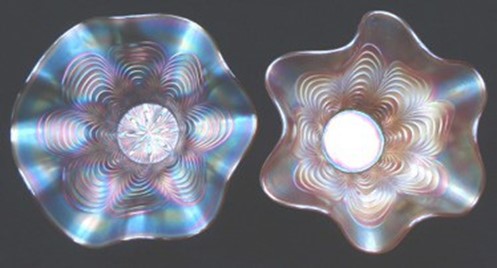
New information regarding Fenton Peacock Tail hat vases: At the ICGA Convention the Mad Hatter was gifted with an unusual example of this hat vase pattern that had been previously covered in this series in the December 2015 issue of The Carnival Pump. Mr. Gale Eichhorst presented me with his marigold example with a blank, unpatterned interior center. This is quite unusual, as most have the continuing peacock pattern all the way to the middle. Carl Booker came to our room to visit and was quite astonished to see it, so much so that he took photos. Current speculation is that this may have been from a small proof run prior to retooling of the mould to produce the examples that most collectors know. I was unaware of this variant when the article was written but would like to show and inform collectors of this unusual hat vase now. Thanks again Gale!
This article first appeared in the ICGA Pump in the September 2016 issue and is reprinted with permission.
Pepper Plant
Pepper Plant is a much less recognized pattern and is so very similar to Fenton’s Holly that one wonders why they bothered to make these two patterns so very similar. Pepper Plant almost always comes with the octagonal base; Holly never does, so this is an easy way to tell them apart. Edge treatments can vary, but like Peacock Tail, the six-ruffle version is the most commonly found. This pattern comes in amethyst, cobalt blue, green, lavender, marigold, vaseline, and possibly others. The exterior of Pepper Plant consists of eight loops extending from the base to about three-fourths inch from the top rim. The interior boasts five plants springing from the interior base. Each plant has five leaves and several bunches of berries or “peppers.” Holly hat vases always have the berries in clumps of three. Pepper plant has several branches showing only one berry. Please refer to the attached close-ups of both Holly and Pepper Plant to view this difference. The red arrows show the single berries as opposed to the triple berry branches always seen on Holly hat vases.
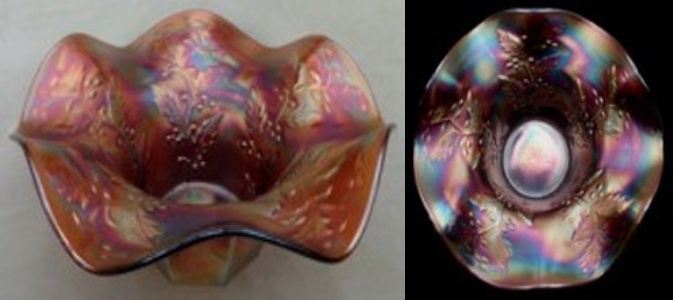
Here are two views of an amethyst Pepper Plant Hat to show the pattern from the side, which shows the base, and from the top.
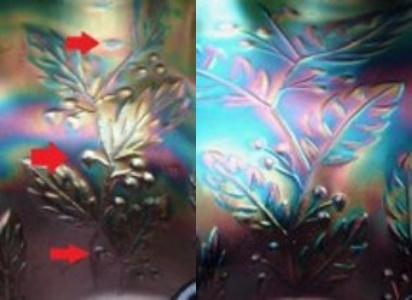
Above left is the Pepper Plant showing several branches showing just one berry. To the right is a Holly hat with groupings of three berries.
Stippled Rays
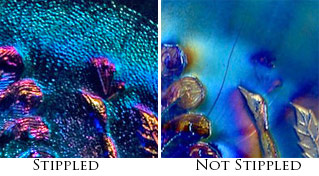
Our final pattern is the ever-common Stippled Rays hat vase. Fenton made a lot of these as early as 1909. Production continued well into the 1920s as red examples have been found. Oddly enough, I wasn’t able to find even one single listing in the Mordini guides from 1996 – 2013. Yet hundreds have been sold, most of them probably on eBay and for very little money. As for me, I have an amethyst one that I wouldn’t part with for all the tea and biscuits at the party. It’s just that pretty, so stunning, and I adore it. It’s pictured here against white and black for your viewing pleasure. It’s like a fantastic sunset or a tie‐dyed bowl. Other base colors are amberina, aqua, blue, celeste blue, lime green, marigold, red, red slag and white. Finding nice examples of this pattern can be a very rewarding adventure, but keep in mind that you may have to kiss a lot of toads before you find your prince.
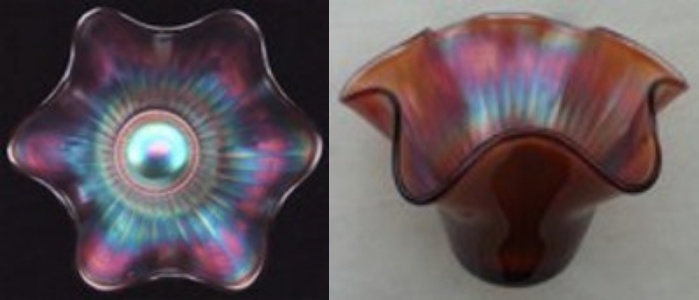
Kate’s favorite Stippled Rays hat is amethyst, seen in two views, from the top and from the side.
So, that concludes yet another installment of the Tales from the Mad Hatter. As usual, there’s a great song to accompany this tea party and naturally, it’s the delightful Gracie Slick and the Jefferson Airplane with their February 1967 mega-classic, “White Rabbit.” https://www.youtube.com/watch?v=YfASumLhC2U This original video is very psychedelic and is via that great old show, The Smothers Brothers Comedy Hour. Take it away Gracie. And remember that it’s always teatime in Wonderland and do keep in mind what the Dormouse said, “Feed your head.”!
Photos courtesy of Kate Lavelle.
This article first appeared in the ICGA Pump in the December 2015 issue and is reprinted with permission.